Minis
Play becomes structured discovery through building, sorting, movement and simple cause and effect.
- curiosity & observation
- shapes & patterns
- hands-on construction
- simple sequences
- language of cause & effect
ROBOTICS AND CODING FOR CHILDREN / PRAGUE
Robotics and coding classes for children and teenagers in Prague, built as a continuous path through logic, mathematics, physics, programming and engineering.
Age is the starting point. Final placement depends on readiness, independence, logic and technical development.
Play becomes structured discovery through building, sorting, movement and simple cause and effect.
Foundations for structured thought through concrete technical tasks and visible cause and effect.
Abstract concepts connect to real system behavior through programming, sensors and measurement.
Independent technical reasoning, advanced programming and reliable autonomous systems.
SUMMER AT NEUSLAB
Each thematic camp is a week-long immersion in one relevant educational topic. We investigate the questions behind it, combine several technical disciplines and turn ideas into practical projects.
Explore summer campsOne focused week
One current topic
Theory through practice
FOR B2B PARTNERS
NeusLab also works with schools, companies, educational organizations and developers of learning technologies to create stronger technical education environments.
Cooperation optionsA task sits at the center. Students learn to connect theory, code and physical behavior into one explainable solution.
Read moreSelect a discipline to see its role in the system.Conditions, structure, decisions and reasoning.
Students do not copy finished instructions. They understand principles, design a solution, test assumptions, detect errors and improve the result.
 PRECISION / RELIABILITY / STRATEGY
Participation is optional and intended for motivated, technically ready students. It is a demanding way to validate skills, not the program's only purpose.
Achievements and competitionsABOUT NEUSLAB
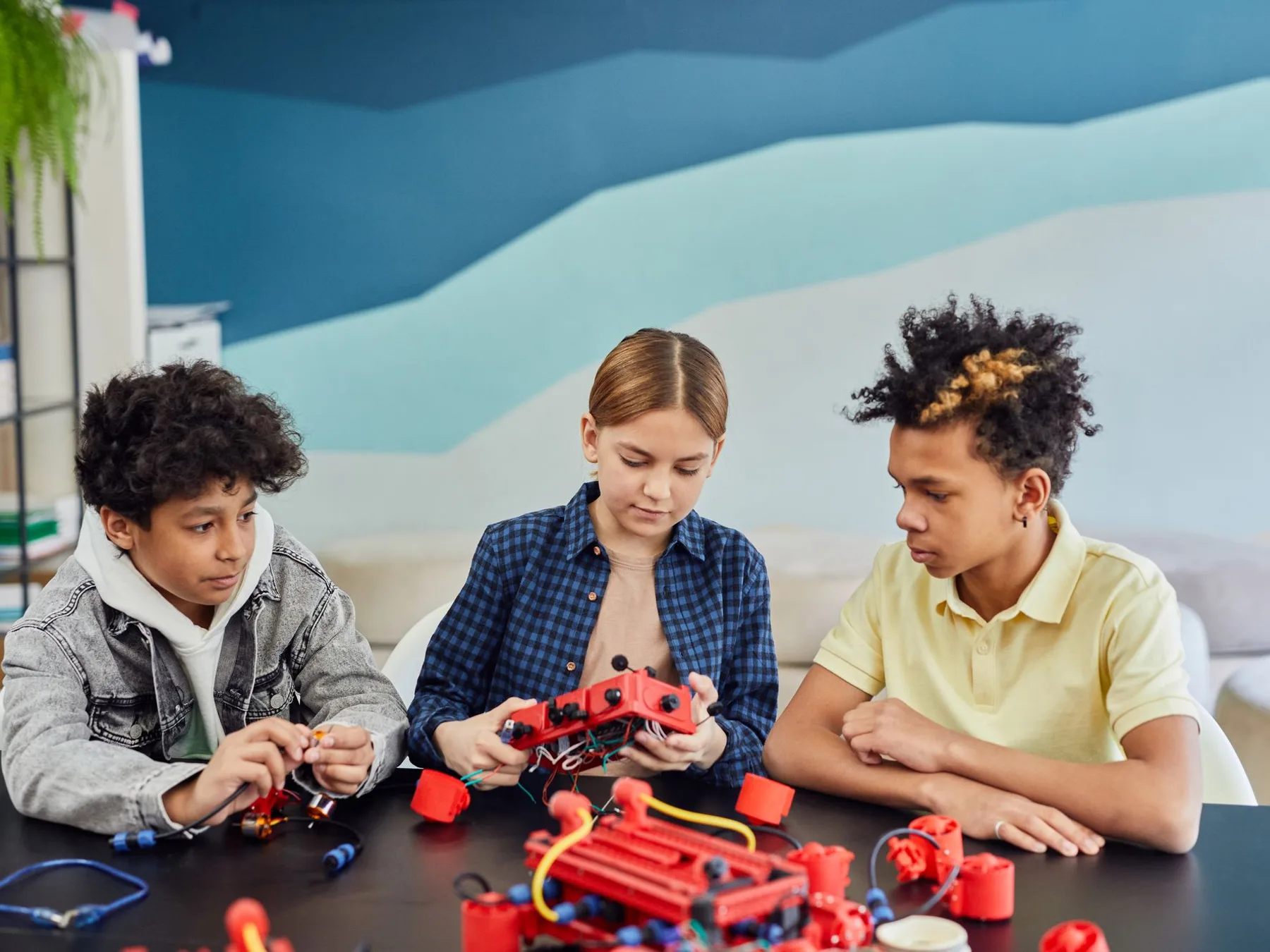
NeusLab is a technology education center where children learn to investigate tasks independently, experiment, analyze mistakes and carry a solution through to a working result.
Our programs are created by specialists who combine teaching experience with practical work in programming, mathematics, engineering and robotics. Groups are intentionally small, so we can respond to each child’s pace, preparation and way of thinking.
More about NeusLabIntentionally small learning groups
Technical practice combined with teaching experience
Individual pace without lowering standards
FAQ
Short answers about choosing a program, readiness and how learning at NeusLab works.
Age is the first guide, not the final decision. Minis is designed for ages 3.5-6, Elementary for 6-9, Junior for 10-14 and Senior for 15-19. We also look at independence, motivation, logic and previous experience during the level assessment.
Children can begin with Minis from around 3.5 years old. At this stage learning is based on building, sorting, movement, observation and simple cause-and-effect relationships.
The programs form one long-term educational system. Students do not simply repeat a prepared project. They learn to understand a task, test ideas, find mistakes and explain why a solution works. Groups are intentionally small.
No previous technical knowledge is required. Curiosity, willingness to participate and readiness to work through mistakes matter more. The level assessment helps us understand whether the format and starting group are suitable.
The frequency depends on the program and the current group schedule. Before enrollment, we confirm the available rhythm and class duration. Regular attendance is more important than trying to move quickly.
Children older than 7 attend the main centre at Kartouzská 4 in Prague 5-Smíchov, where lessons last two hours. Children up to and including age 7 attend the Vinohrady branch at Mánesova 1656/88 in Prague 2, where lessons last one hour.
A two-hour lesson at the Smíchov centre costs CZK 800. A one-hour lesson at the Vinohrady branch costs CZK 450.
CONTACT NEUSLAB
Ask about our programs, partnerships or current opportunities. We will reply with a clear next step.